Ecommerce Video Production Cost: 2026 Pricing Guide
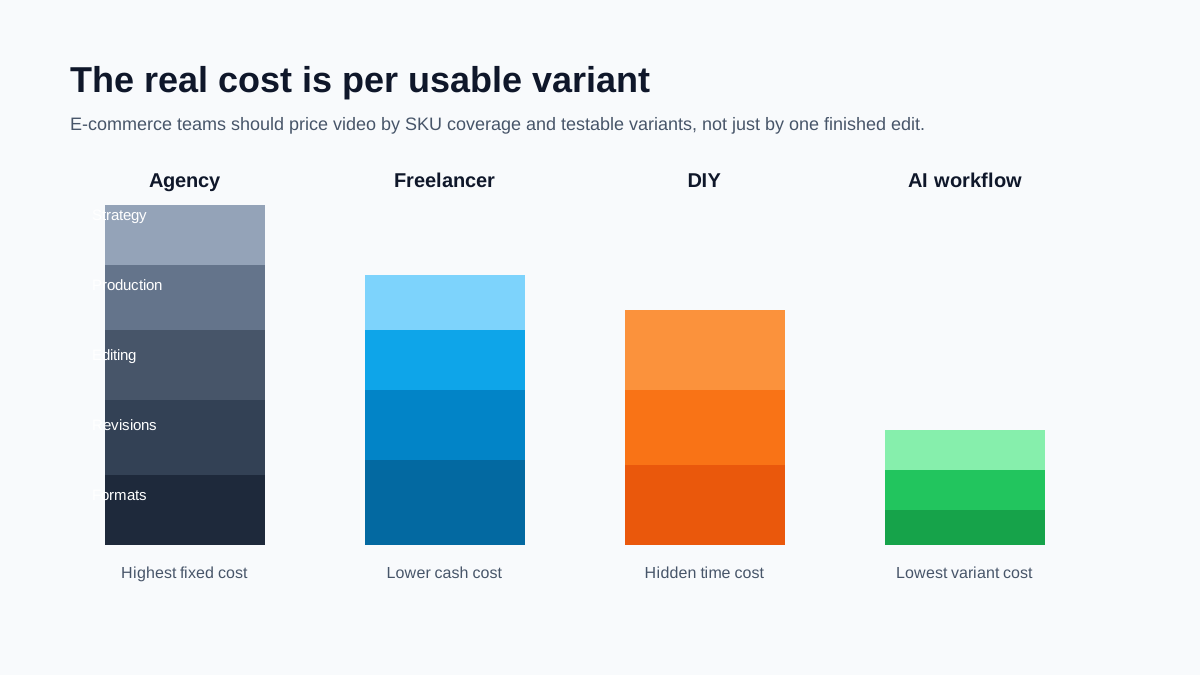
Ecommerce video production cost is not just the price of one finished video. For an online store, the real cost is the cost of producing enough usable product video variants across enough SKUs to improve conversion, run paid tests, refresh creative, and support platform-specific formats.
That is why a $300 product video can be expensive if it produces one weak asset, while an AI workflow can be cheaper even if you generate dozens of drafts and discard most of them. The useful metric is cost per usable variant, not cost per export.
This guide breaks down 2026 ecommerce video production costs across agency, freelancer, DIY, and AI workflows. It also shows how to calculate hidden costs, when traditional production still makes sense, and when AI video generation is the more practical option for catalog-scale sellers.
If you are comparing tools, read Best AI Video Generators for E-Commerce Sellers. If you need the creation workflow first, start with How to Create E-Commerce Product Videos with AI.
Quick answer: how much does ecommerce video production cost?
Typical ecommerce video production costs vary by production method:
| Production method | Typical cost range | Best for | Main limitation |
|---|---|---|---|
| Full-service agency | $3,000-$20,000+ per project | Hero campaigns, premium launches, brand films | Too slow and expensive for SKU-level volume |
| Video production company | Often under $10,000 per project on Clutch, but average reviewed projects can be much higher | Polished videos with professional process | Cost rises with filming, effects, crew, and timeline |
| Freelancer | $50-$500+ per short product edit, depending on scope | Small batches, editing supplied footage | Briefing, revisions, and footage sourcing add hidden cost |
| DIY filming and editing | Low cash cost, high time cost | Founder-led stores, early tests | Time, skill, lighting, reshoots, and consistency |
| AI video workflow | Low marginal cost per variant after setup | Catalog videos, ad testing, TikTok Shop, Shopify PDP videos | Needs human review for claims, quality, and brand fit |
These ranges are directional. Your actual cost depends on product category, filming requirements, model or creator needs, number of variants, revision rounds, licensing, platform formats, and whether you already have product images or video footage.
Why ecommerce video costs are different from brand video costs
A traditional video production quote usually prices a project: one shoot, one edit, one timeline, one final deliverable. Ecommerce needs a different model.
An online seller often needs:
- One product page video for each important SKU
- Multiple short ad variants for TikTok, Instagram, YouTube Shorts, and Meta placements
- Seasonal updates for discounts and gifting moments
- Retargeting videos that answer buyer objections
- Product comparison videos
- UGC-style videos for social proof and native-feeling ads
- Store-specific edits for Shopify, Amazon, TikTok Shop, or marketplace pages
That means the cost problem is multiplied by catalog size.
Example:
| Scenario | Videos needed | Why |
|---|---|---|
| 10 SKU store, basic coverage | 10-20 videos | One product page video plus one ad variant |
| 10 SKU store, testing seriously | 50-80 videos | 5-8 variants per priority SKU |
| 100 SKU store, basic coverage | 100-200 videos | One or two videos per SKU |
| 100 SKU store, paid creative engine | 500+ videos | Creative testing and refresh cycle |
This is where agency or manual editing costs break down. The seller does not need one cinematic video. They need a repeatable video production system.
Cost component breakdown
The total cost of ecommerce video production is the sum of several layers.

| Cost component | What it includes | Often forgotten? |
|---|---|---|
| Creative strategy | Hook, script, storyboard, concept, offer, CTA | Yes |
| Product prep | Samples, shipping, staging, cleaning, packaging | Yes |
| Production | Crew, lighting, location, camera, model, creator | No |
| Post-production | Editing, color, captions, voiceover, music, motion graphics | No |
| Revisions | Feedback rounds, fixes, new cuts | Yes |
| Format versions | 9:16, 1:1, 4:5, 16:9, product page crop | Yes |
| Compliance review | Claims, usage rights, endorsements, marketplace policies | Yes |
| Distribution setup | Uploading, naming, tagging, adding to product pages | Yes |
| Opportunity cost | Time waiting for assets before testing | Almost always |
Formula:
Total ecommerce video cost = (concept + assets + production + editing + revisions + formats + review) x SKUs x variants per SKU
That formula explains why a cheap manual edit can still become expensive. If each product needs five versions, every hour of editing and every revision round compounds.
Option 1: Full-service agency
Agency production is the highest-quality and highest-cost route. It can include strategy, scripting, filming, lighting, directors, camera operators, models, editors, motion designers, licensed music, and delivery in multiple formats.
Use agency production when:
- You are launching a hero product
- The product has high average order value
- Brand perception is a major part of the purchase decision
- You need premium lifestyle footage
- The video will be used across paid media, homepage, retail, investor decks, or press
Avoid agency production for:
- Every SKU in a large catalog
- Weekly creative testing
- Simple product demos
- Minor offer changes
- TikTok Shop or UGC-style volume testing
Clutch's 2026 video production pricing guide notes that video production agency hourly rates commonly fall in the $100-$149 range, and project costs vary based on scope, runtime, complexity, location, crew, actors, and effects. That is reasonable for premium production. It is usually not reasonable for testing 50 hooks across a product catalog.
Option 2: Freelancer
Freelancers can be a practical middle ground when you already have assets.
Common freelancer use cases:
- Editing product clips you filmed yourself
- Turning product images into a slideshow or motion graphic
- Adding captions, cuts, music, and basic motion
- Creating TikTok-style edits from supplied footage
- Reformatting existing videos for vertical platforms
The hidden cost is coordination:
| Hidden cost | Why it matters |
|---|---|
| Briefing | A vague brief creates generic videos and extra revisions |
| Asset preparation | You may still need product images, footage, logos, and claims |
| Revision time | Two revision rounds can double turnaround time |
| Batch inconsistency | Multiple freelancers may produce different visual quality |
| Platform knowledge | A good editor may not understand TikTok Shop, Shopify PDP, or ecommerce conversion |
Freelancers work best for targeted execution, not for building an always-on creative testing machine.
Option 3: DIY production
DIY looks cheap because the cash cost is low. But it is rarely free.
Possible costs:
| Cost item | Typical range |
|---|---|
| Smartphone tripod or gimbal | $30-$200 |
| Lighting | $30-$300 |
| Backdrop and props | $20-$200 |
| Microphone | $30-$150 |
| Editing software | $0-$60/month |
| Your time | 1-5 hours per usable video for many beginners |
The time cost matters. The U.S. Bureau of Labor Statistics reported median annual wages of $70,980 for film and video editors and $68,810 for camera operators in May 2024. That does not mean every ecommerce seller should use those exact rates, but it shows that filming and editing are skilled work. If a founder spends four hours creating one average product video, that time has a real business cost.
DIY is best when:
- You are early and cash-constrained
- Founder personality is part of the brand
- The product is easy to film
- You want authentic behind-the-scenes content
- You are learning which hooks deserve more budget
DIY is weak when:
- You need consistent videos across many SKUs
- Your product requires controlled lighting or specialized demos
- You need weekly testing volume
- Your time is better spent on sourcing, merchandising, ads, or conversion work
Option 4: AI video workflow
AI changes the unit economics of ecommerce video because it reduces the cost of producing variants.
Instead of filming every scene from scratch, an AI workflow can start with:
- Product images
- Product descriptions
- Key benefits
- Buyer objections
- Platform choice
- Hook templates
- Brand style guidance
Then it generates multiple versions for review. The best use case is not replacing every premium brand campaign. The best use case is producing the large number of practical product videos most ecommerce teams never create because manual production is too slow.
AI works especially well for:
- Shopify product page videos
- TikTok Shop product videos
- YouTube Shorts product explainers
- Instagram Reels product demos
- Product image-to-video tests
- Retargeting videos
- Catalog coverage
- Hook and angle testing
Use ShopShot's AI video tools if you need a workflow designed for ecommerce rather than general video editing. For channel-specific workflows, use TikTok Shop Video Generator, Shopify Product Videos, and YouTube Shorts Generator.
Cost comparison: 10 products and 100 products
The difference becomes clear when you model catalog size.
Scenario A: 10 products, 5 variants each
| Method | Videos | Estimated total cost pattern | Operational reality |
|---|---|---|---|
| Agency | 50 | Usually impractical unless bundled into a major campaign | High quality, slow, expensive |
| Freelancer | 50 | Moderate to high depending on edit complexity | Requires briefs and revisions |
| DIY | 50 | Low cash cost, high time cost | Could consume weeks |
| AI workflow | 50 | Low marginal cost after setup | Requires review and testing |
Scenario B: 100 products, 3 variants each
| Method | Videos | Practicality |
|---|---|---|
| Agency | 300 | Not practical for most sellers |
| Freelancer | 300 | Possible but operationally heavy |
| DIY | 300 | Not realistic for most teams |
| AI workflow | 300 | Practical if the process is templated |
This is why ecommerce teams should think in systems. The question is not "How much does a product video cost?" The better question is "How much does it cost to keep our best-selling products supplied with fresh, accurate, platform-ready video variants?"
When traditional production is still worth it
AI is not always the right answer.
Use professional production when:
- The product is expensive and trust depends on premium visuals
- You need real human use cases, models, or environments
- The product requires demonstration that AI cannot show accurately
- You need brand campaign assets for multiple channels
- You need legally sensitive claims documented through real testing
Use AI when:
- The product can be explained visually from existing images
- You need many creative variants quickly
- You are testing hooks before scaling spend
- You need Shopify PDP videos across many products
- You need TikTok Shop or short-form videos at volume
- You cannot justify manual editing for every SKU
Many ecommerce teams should use both. AI handles the daily creative engine. Professional production handles the few hero assets where premium original footage changes buyer trust.
How to reduce ecommerce video production cost
- Build a product truth file once.
Use the same product facts across Shopify, TikTok Shop, Instagram, YouTube Shorts, and paid ads.
- Separate hero assets from test assets.
Do not spend agency budget on unproven hooks. Use AI or low-cost production to identify winning angles first.
- Batch by product category.
Create templates for skincare, apparel, gadgets, home goods, pet products, or accessories. Category templates reduce briefing time.
- Reuse the proof scene.
If the same demo proves the product, create multiple hook and CTA variants around it.
- Measure cost per winner.
If you spend $500 creating 50 AI variants and 5 are usable winners, your cost per winner is $100. If you spend $1,000 on one manual video that does not convert, your cost per winner is undefined.
- Add videos first to highest-impact pages.
Start with products that already get traffic, paid spend, or high purchase hesitation. For Shopify, see How to Make Product Videos for Shopify Without a Camera. For TikTok Shop, see How to Make TikTok Shop Product Videos with AI.
Recommended budget model
For a small ecommerce store:
| Budget stage | Recommended approach |
|---|---|
| First 10 videos | Use AI plus manual review to test product angles |
| First winning product | Add a higher-quality product page video and retargeting edits |
| First paid ads | Generate 5-10 variants around the best hook |
| Scaling | Use AI for variant volume and hire creators or freelancers for proven winners |
| Brand campaign | Use agency or professional production only for hero assets |
This prevents overspending before you know which product message works.
FAQ
What is the average ecommerce product video cost?
There is no single average because cost depends on production method, scope, length, crew, editing, revisions, and number of variants. For ecommerce, cost per usable variant is a better metric than cost per finished export.
Is AI video cheaper than hiring a freelancer?
AI usually has a lower marginal cost for creating many variants, especially when you already have product images and descriptions. A freelancer may still be useful for polishing winners, editing real footage, or handling brand-specific creative direction.
When should I pay for professional video production?
Pay for professional production when a hero product, premium campaign, or high-value brand asset needs original footage, models, locations, or a level of trust AI cannot provide.
How many product videos does an ecommerce store need?
Start with one product page video for each high-traffic or high-margin SKU, then create 3-8 short-form variants for products you promote with TikTok Shop, Meta, Instagram, or YouTube Shorts.
What is the hidden cost most sellers miss?
The biggest hidden cost is revision and variant production. One video is rarely enough. Sellers need multiple hooks, formats, and placement-specific edits before they find a winner.